
Olympic-grade textiles
What are the fabrics that make it to the podium?

With the Olympics soon coming to a close, and the Paralympics set to open, I thought we could take a look at the materials that go into creating a gold medalist.
Safe to say, knitting has taken the Olympics by storm. Some may remember Tom Daley, the UK diver, who shot to fame during the Tokyo summer Olympics for what then was considered an unconventional and quirky hobby for an Olympian. Namely – knitting. He shared with the world that he found it helped him relax and manage stress, and therefore a key for the world’s largest sports competition.
With the winter Olympics here, and the weather perfect for cozy knittnig, this “trend” has taken root among athletes. Olympic knitters were everywhere.

It got me thinking – besides the knitwork that’s produced on the sidelines, what other textiles and materials go into sending an athlete to the Olympics?
Come and explore with me.
Hopeful headlines in tech
Inter / section
The sports and athleticism of the Olympics are without a doubt impressive. Yet it is not only sheer athletic strength, skill, and perseverance that get them there. There is an incredible amount of craft and research that goes into honing the environment to produce the best results. Here’s one bit on the craft behind the Olympics, which hits the nail on the head:

When it comes to textile and material innovation, every little bit counts. Just a 1% improvement can be the difference between a medal or not. This is also the argument that Norwegian scientists use in their claim that the fastest colour is, wait for it…blue. I kid you not.
So without further ado, let’s take a look at the craft and innovation behind some of the materials we’ve seen at the Olympics.
Country uniforms
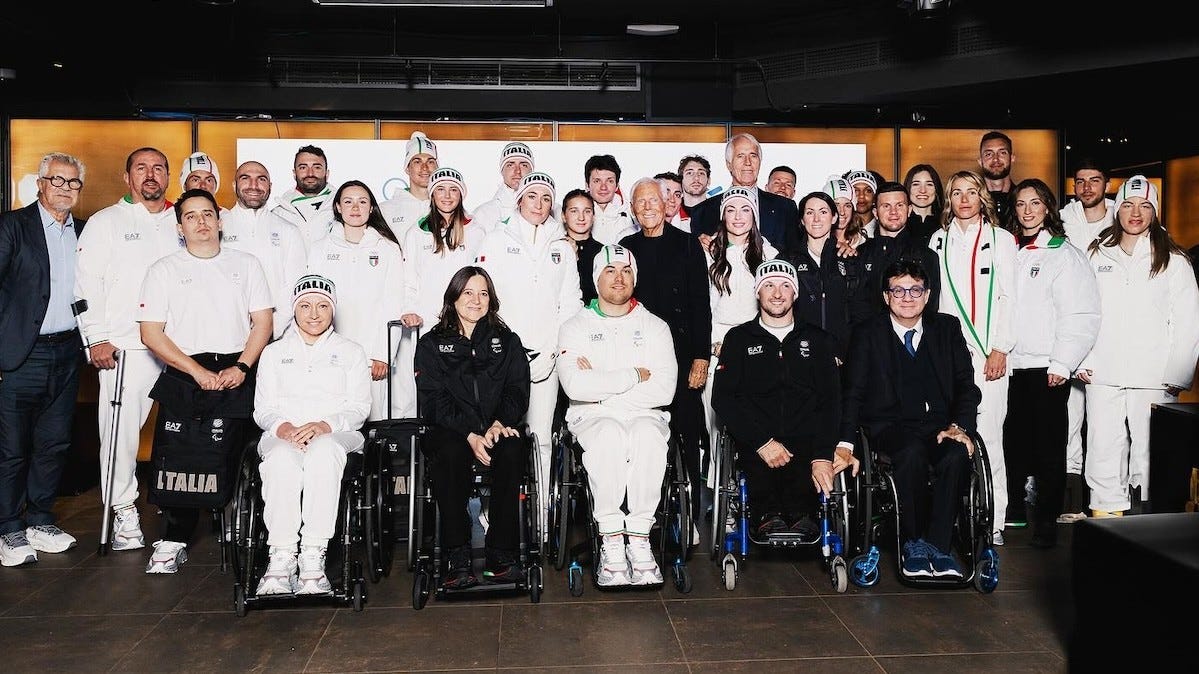
The first things that come to mind when it comes to textiles and the Olympics, are the much-discussed national team outfits. Sure, they feature their national colours, their brands (like the Italian team’s outfits designed by Armani, Ralph Lauren outfitting the Americans, the Canadians were once designed by Roots, and now Lulu Lemon). But what got me more excited was to consider what they were made of.
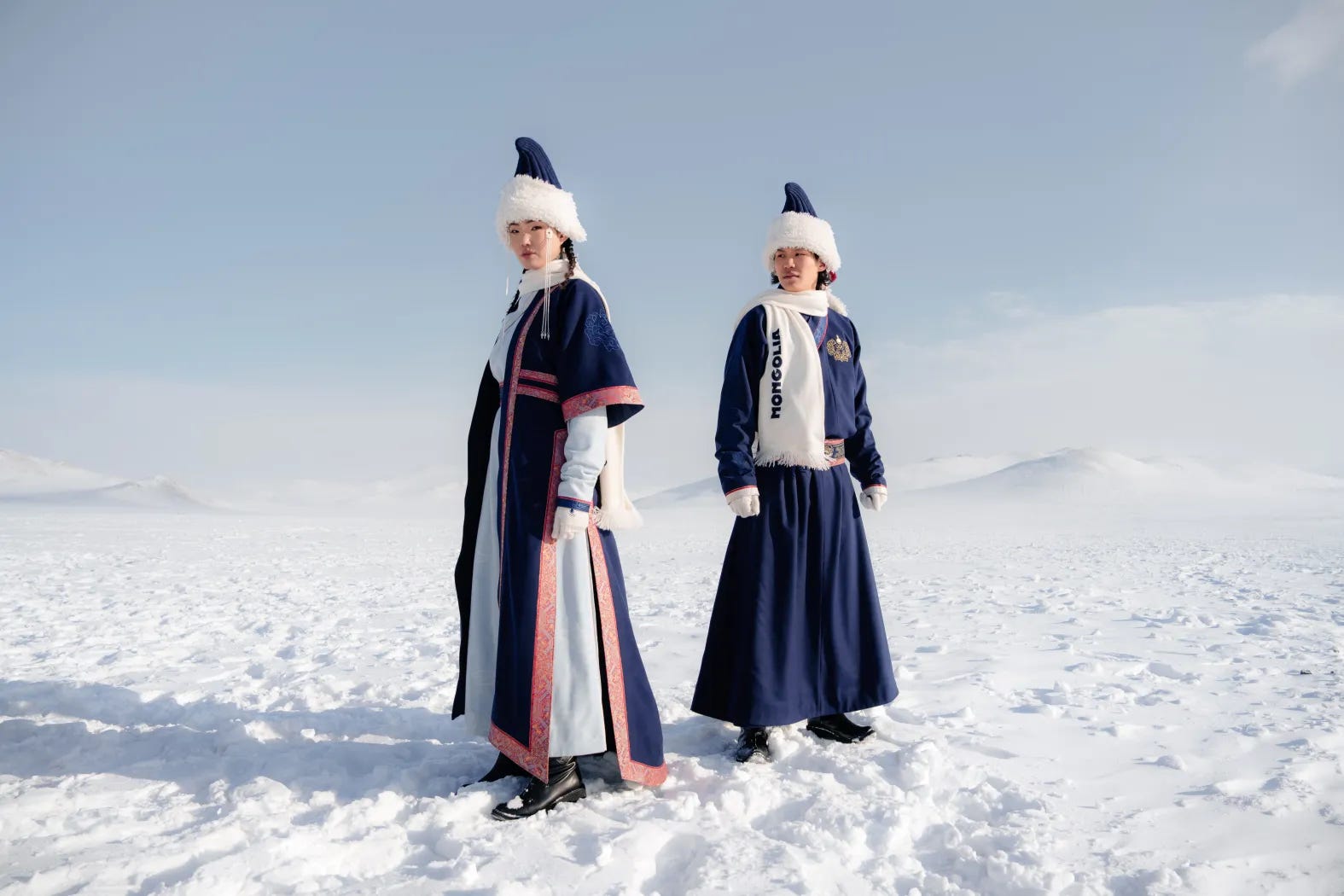
Mongolia shone not only with their design, but with their choice of textile. They featured the Mongolian national costume, but made it out of cashmere – a fiber that comes from cashmere goats, and is only found in some countries. After China, Mongolia is the world’s second-largest producer of cashmere.
Norway kept true to their winter roots by featuring knit wool sweaters with a distinctive colourwork technique, which not only looks great, but also contributes to a warmer sweater thanks to the double-layer of yarn (one for each colour). The exterior is pure Norwegian wool, while an inside lining is made out of 100% merino wool for extra softness.
Fun fact: it’s modeled after the same sweater the Norwegian team wore to the Olympics 70 years ago, also in Cortina, which also happened to be the first year that this deisnger designed for the Norwegian Olympic team! Talk about legacy-stacking.


Textile innovations
Is everyone just wearing spandex and lycra? This was a legit thought that ran through my head as I watched the downhill skiiers wiz down the slope at breakneck speed. Because it sure looks like a regular-ol’ spandex suit.
But of course, the textile engineers have had their say.
The development of winter-wear is a collaboration between designer and textile scientist, so that it not only looks good, but also gives the athlete the best chance at winning. Because every little detail (particularly when it’s freezing cold), is important.
For example, the Armani team collaborated with textile innovators to develop and implement the Protectum7 technical fabric, which is lightweight, waterproof, yet breathable, onto their coats and snow pants. They use their Stratum7 insulation, a microfiber made out of recycled plastic bottles, to keep the wearer warm and keep sustainability in mind.
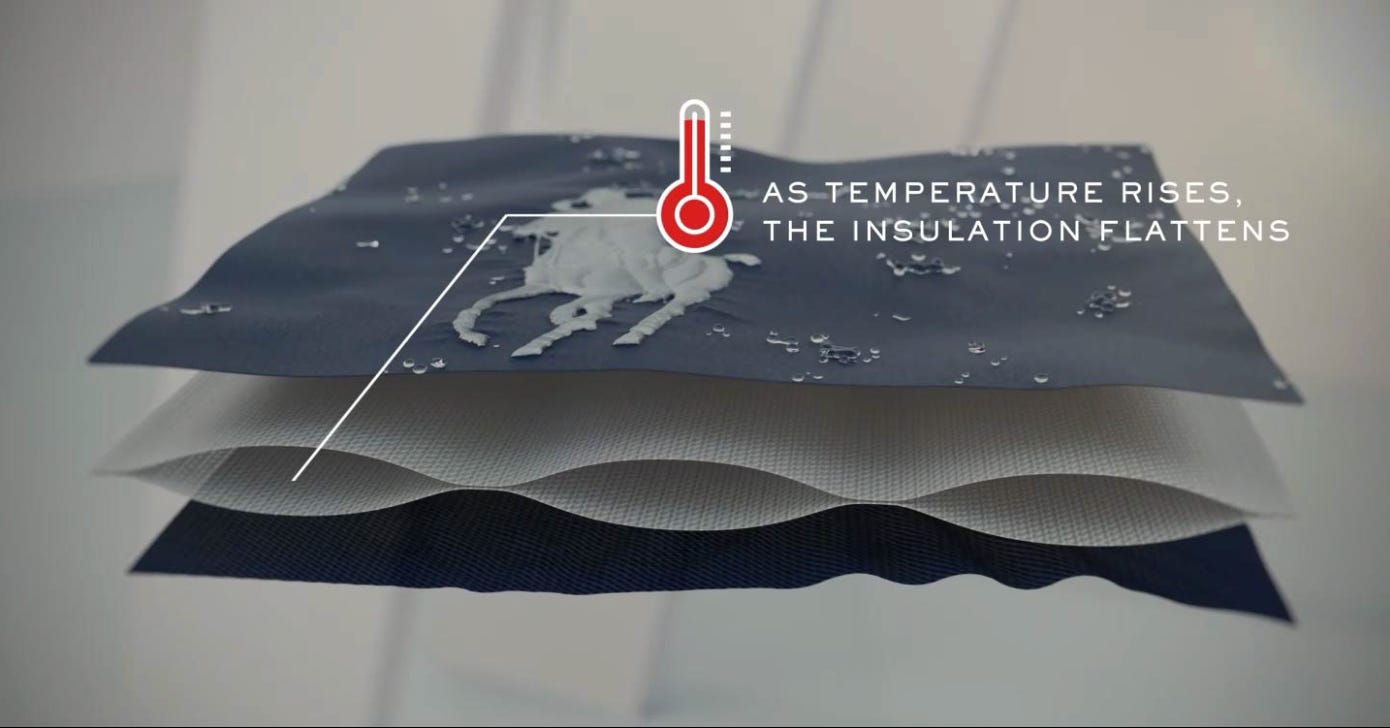
Ralph Lauren holds a patent for “intelligent insulation”, which is a temperature-responsive fabric system that adapts to the environment you’re in (or moving through). Say you’re moving from indoors to outdoors a lot – you wouldn’t need to change coats. The technology is really cool:
“As temperatures drop, the lengths of the two materials change differently causing the textile to constrict and bend – creating channels in the fabric structure to increase the amount of insulation provided by the garment.”
Underarmour, also tasked with developing competition-wear for team USA, collaborates with labs such as the in North Carolina was tasked with developing a textile in collaboration with the lab at the Wilson College of Textiles in North Carolina. One of the tools they use to test the effectiveness of their fabrics is a sweating dummy, so that they can see how moisture-wicking a fabric really is. Here’s a quick video, an insight into their lab.
One of the most bizarre textile-related “innovations” caused a scandal and almost resulted in the Norwegian ski-jumping team being suspended. They call it…crotch-gate.

In 2025, the Norwegian team had been found to have reinforced the crotch area of their suits with harder materials. This increases the wind-resistance of their body, and supposedly just one extra centimeter of “reinforcement” can lead to 3 meters more of flight (some athletes were even rumoured to have injected their genital area with hyaluronic acid to increase bulge size).
Naturally, when the IOC cottoned on to this, the practice was banned. Now, the Cortina Olympics involve much stricter suit inspections, with lots of tech involved. They go through 3D screening for accurate measurements, and tamper-proof microchips are then affixed to the suit.
Media of the week
A friend who I met through the European startup community, Matt Smith (whose main shtick is audiovisual media, video journalism, MCing, etc.), did what I thought was impossible – he just decided one day that he wanted to go to the Olympics. At the time I though “yeah, good luck buddy”, but guess what. He made it! Check out his story:

Project of the week
This week I did the big thing – I finished weaving the shawl! It was a rocky road – I had to undo, weave, and undo again, quite a lot until I achieved the correct tension for those final colourful stripes.
Please enjoy my final rows, cutting off the tassels, and enjoying my work with what was a very cold cup of tea.
Next up – taking it off the loom!
Until next week,
Julia
Thank you for those Olympic stories! While I'm not actively following the event, this kind of summary and insight is very nice! 🫶🏻
And I can't wait to see the finished shawl off the loom! Yaaay!